MIL-STD-810 is an environmental test standard used to check how equipment behaves under demanding conditions. Although it originated in the U.S. military sector, today it is used as a reference in defense, industry, transportation, naval, automotive, and rugged electronic equipment.
MIL-STD-810 certification does not mean a product is indestructible. It means it has been designed and tested under specific methods to withstand certain scenarios: vibration, shock, temperature, humidity, dust, rain, altitude, salt fog, or other conditions depending on the application.
In the case of Inelmatic, displays and monitors for military use are designed for harsh environments where hardware must operate reliably, with a rugged structure, suitable touch technology, and resistance to impacts and vibrations.
What is MIL-STD-810 and why it matters in rugged equipment
MIL-STD-810 is a test method standard. Its goal is to help evaluate whether equipment can withstand environmental conditions relevant to its real-world use. Not all products undergo all tests; the methods that make sense for the operating environment are selected.
This is important because a monitor installed in a military vehicle does not face the same risks as a fixed industrial display, naval equipment, or an outdoor information panel. The standard allows translating those requirements into measurable, comparable, and documentable tests.
What tests are included in MIL-STD-810 certification
Test methods can vary depending on the version and project, but they typically cover mechanical, climatic, and environmental conditions. For a ruggedized monitor, the most relevant tests usually involve vibration, impact, temperature, humidity, and particle or water ingress when combined with other protection requirements.
Vibration: simulates continuous movement in vehicles, machinery, or transportation.
Shock: evaluates the response to sudden impacts or drops.
High and low temperature: verifies operation and survival in extreme ranges.
Humidity: analyzes behavior under condensation or humid environments.
Dust and sand: assesses resistance in environments with abrasive particles.
Salt fog: relevant for marine applications or exposure to corrosive environments.
Passing one test does not automatically guarantee passing all of them. Therefore, it is key to specify which methods were applied, under what conditions, and with what results.
MIL-STD-810G, MIL-STD-810H, and other versions of the standard
It is common to find references to MIL-STD-810G or MIL-STD-810H. Each version updates procedures, criteria, and testing approaches. The specific version matters, but even more important is knowing which methods were tested and how they relate to the real use of the product.
A frequent mistake is using the standard as a generic commercial label. For a technical buyer, the value lies not just in reading “MIL-STD compliant,” but in having clear information regarding vibration, shock, temperature, humidity, or other applicable tests.
How equipment is designed to pass MIL-STD-810
Ruggedness is not achieved at the end of the project. It must be incorporated from the design stage. In a rugged display, the casing, front panel, connectors, internal mounting, thermal dissipation, electronics, sealing, and mounting method all play a role.
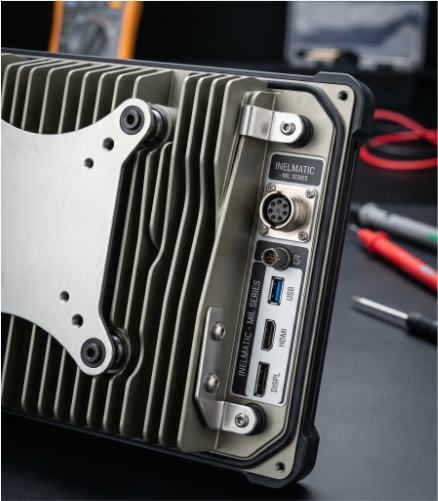
Rugged displays with adequate mechanical structure
A well-designed metal casing helps absorb vibrations, protect electronics, and maintain the integrity of the unit. Mounting points, material thickness, surface treatment, and compatibility with the installation environment also play a crucial role.
Metal-enclosed industrial displays are a good example of how the structure can adapt to environments where IP protection, mechanical resistance, and stable operation over long periods are required.
MIL-STD-810 in touchscreen monitors and defense displays
On a touchscreen, the front panel is critical. It must allow interaction while also withstanding impacts, vibrations, cleaning, reflections, and temperature changes. The choice between resistive or capacitive touch, glass type, optical bonding, and sealing can determine actual performance.
In defense or naval applications, it may also be necessary to combine MIL-STD-810 with other requirements: electromagnetic compatibility, specific connectors, protected power supplies, sunlight readability, or salt fog resistance.
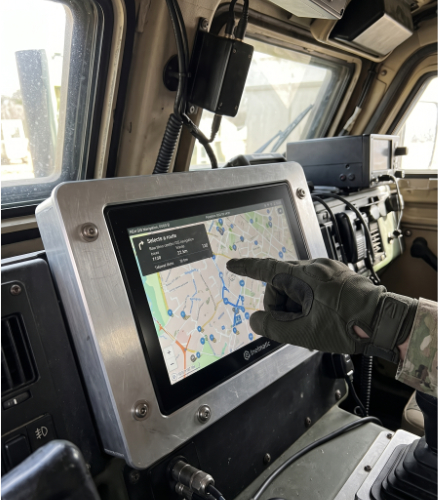
MIL-STD-810, IP ratings, and rugged equipment: they are not the same
MIL-STD-810 focuses on environmental test methods. IP ratings indicate protection against dust and water ingress. A ruggedized device is designed to withstand harsh conditions, but that term alone does not define which tests it has passed.
The right combination depends on the application. An outdoor screen may need high brightness, anti-reflective treatment, and IP65. Naval equipment may require corrosion resistance. A military monitor may prioritize vibration, shock, temperature, and rugged connectors. What matters is translating the environment into verifiable technical requirements.
What to ask before buying a MIL-STD-810 certified monitor
Before choosing equipment, it is best to ask for precise information. A generic mention of the standard is not enough. It is recommended to check which methods were tested, in what laboratory, under what conditions, with what acceptance criteria, and whether those tests match your use case.
You should also review aspects that do not always appear on a quick spec sheet: thermal range, brightness, connectors, mounting, power supply, optical treatment, sealing, repairability, and component availability. A rugged product must be tough, but also maintainable and easy to integrate.
Working with Inelmatic allows tailoring the design, structure, display, CPU, and integration options to the specific requirements of the project, especially when the customer needs more than a standard product.
Conclusion on MIL-STD-810 in rugged displays
MIL-STD-810 certification is a useful benchmark for evaluating environmental resistance, but it must be interpreted rigorously. What matters is not just the name of the standard, but which tests were passed and whether they align with the actual operating environment.
In industrial monitors, defense, naval, or transportation applications, designing for MIL-STD-810 means working from mechanics, electronics, touch technology, sealing, and integration. When all these elements align, the result is a more reliable unit in conditions where a conventional monitor would fall short.
Frequently Asked Questions about MIL-STD-810
What is MIL-STD-810?
MIL-STD-810 is an environmental test standard used to evaluate how equipment responds to vibration, shock, temperature, humidity, dust, rain, or other demanding conditions.
Does MIL-STD-810 mean equipment is military-grade?
Not necessarily. Although the standard originates from the military sector, it is also used in industry, transportation, rugged electronics, naval, and applications where equipment must endure harsh conditions.
What is the difference between MIL-STD-810G and MIL-STD-810H?
They are different versions of the standard. Each updates test methods and criteria. To evaluate a product, you should review the applied version and specific tested methods.
Is MIL-STD-810 the same as IP65?
No. MIL-STD-810 evaluates environmental resistance through test methods. IP65 indicates protection against dust and water jets. They can complement each other, but measure different aspects.
Which tests are important for a military monitor?
Vibration, shock, temperature, humidity, salt fog, dust, readability, power supply, and mechanical resistance are usually key, though selection depends on the operating environment.
When should you choose rugged displays with MIL-STD-810?
When equipment will be installed in defense, transportation, naval, outdoor, heavy machinery, or environments with shocks, vibrations, extreme temperatures, humidity, or high reliability demands.