The CAN bus is one of the most widely used communication systems in vehicles, mobile machinery, and embedded industrial equipment. Its function is to allow different electronic units to exchange information in an orderly, fast, and reliable manner without relying on point-to-point wiring for every signal.
In a bus, a train, a special vehicle, or an industrial machine, this communication can connect sensors, control units, displays, diagnostic systems, HVAC modules, driver assistance equipment, and on-board computers. Therefore, understanding how the CAN bus works helps in making better decisions when a project requires integrating electronic hardware into a demanding mobile environment.
What CAN bus in vehicles is and why it is used
CAN stands for Controller Area Network. It is a communication protocol designed for multiple electronic devices to share data within the same internal network. Instead of connecting each module to all others through independent cables, the system uses a common line through which identified messages travel.
The main advantage is that it reduces wiring, weight, and complexity—something especially important in vehicles where space, vibration, temperature, and reliability are critical factors. One module can send door status, another can report an alarm, another can transmit speed data, and a screen can show useful information to the driver or passengers.
In transportation projects, this architecture is very useful when integrating vehicle displays, HMI panels, media players, passenger information systems, or diagnostic equipment. Communication is not limited to sending data: it allows the entire system to react cohesively.
How the CAN bus works in an embedded system
CAN bus operation is based on messages. Each device connected to the network can transmit information, but messages are not addressed to a single specific receiver; instead, they are broadcast with an identifier. Other devices read the network and act only if that message is relevant to them.
This logic allows the system to be flexible. For example, a control unit can issue a status signal and several displays or modules can use it at the same time. If the message indicates an incident, a cabin display can alert the driver while another piece of equipment logs the event for maintenance.
CAN bus and message priority in vehicle communication
A key feature of the CAN bus is prioritization. When multiple devices attempt to communicate at the same time, the protocol determines which message takes precedence based on its identifier. Thus, a critical signal can take priority over a less urgent one without crashing the system.
This point is essential in environments where safety, operational, maintenance, and user information data coexist. A content update for an entertainment display does not have the same priority as a technical warning regarding vehicle status.
CAN bus, displays, and embedded equipment in public transportation
In public transportation, the CAN bus can form part of a broader on-board information architecture. Driver displays, passenger panels, media players, ticketing systems, and on-board computers may require vehicle data to display messages, activate operating modes, or log events.
For example, a screen can adjust its brightness based on day or night mode, show contextual information, receive central system alerts, or integrate with infotainment solutions. In these cases, the value lies not only in the display itself, but in its ability to communicate seamlessly with the vehicle's electronic environment.
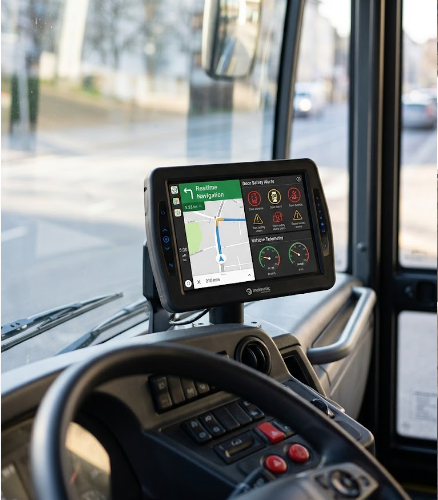
Inelmatic works specifically in these scenarios, where hardware must adapt to the vehicle, communication protocol, mounting format, and real-world usage demands. Its digital communication and signage solutions for transportation can combine custom displays, monitors, media players, and electronics.
Advantages of the CAN bus in embedded hardware projects
The CAN bus remains relevant because it solves very specific integration challenges. In industrial or mobility projects, its main advantages are:
Reduces wiring and simplifies installation inside the vehicle.
Allows multiple modules to share information without dedicated connections between them all.
Provides robust communication against interference and harsh conditions.
Facilitates diagnostics, maintenance, and event traceability.
Allows prioritizing critical messages so the system responds safely.
These advantages explain why it is used in buses, trains, special vehicles, heavy machinery, autonomous platforms, and mobile industrial solutions. Even so, its integration must be carefully designed: having CAN capability on a device is not enough; it must interpret the right messages, withstand the electrical environment, and maintain stability over years.
What to review before integrating CAN bus into vehicle displays
Before choosing a display, Panel PC, or on-board computer to work with CAN, it is advisable to review electrical and protocol compatibility: communication speed, connectors, isolation, power supply, transient resistance, and message documentation.
The second criterion is the physical environment. A vehicle introduces vibration, temperature swings, sun exposure, dust, humidity, and space constraints. Therefore, an office solution is usually not suitable for a cabin, dashboard, bus interior, or mobile industrial area.
The third criterion is the product lifecycle. In transportation and industry, projects are not renewed every year. A good design must account for component availability, customization possibilities, technical support, and continuity. At this point, working with Inelmatic helps adapt electronics, mechanics, optics, and software to the actual project, not the other way around.
CAN bus and HMI displays: when a custom solution makes sense
A standard solution may be sufficient if the display only shows static content or receives video input. However, when it needs to interact with the vehicle, interpret signals, trigger alerts, or interface with specific protocols, a custom solution is typically safer.
Industrial HMI displays and Panel PCs allow processing, visualization, and communication interfaces to be integrated into a single device. This is useful when the device must act as a control point, diagnostic panel, driver interface, or smart display within an embedded system.
The key is to define from the outset what data will be read, what information must be displayed, how the system will be updated, and what certifications or testing the final product requires. The earlier that architecture is locked down, the lower the risk of costly redesigns.
Frequently Asked Questions about CAN bus and vehicle communication
What is the CAN bus in a vehicle?
The CAN bus is an internal communication network that allows different electronic modules in a vehicle to exchange messages in a robust and organized manner.
What is the purpose of CAN bus in vehicle displays?
It allows a display or on-board device to receive vehicle telemetry data, display alerts, change operating modes, or integrate with other electronic systems.
Is the CAN bus used only in automotive applications?
No. It is also used in public transportation, industrial machinery, special vehicles, railway systems, mobile robotics, and other applications requiring reliable communication.
What is the difference between CAN bus and Ethernet?
CAN is designed for short, robust, and prioritized messages in control systems. Ethernet offers higher bandwidth, but does not always replace CAN in vehicle environments.
What must a CAN bus compatible display feature?
It must have the appropriate interface, correct electrical protection, integration documentation, environmental resistance, and the ability to interpret relevant system messages.
When should you choose an Inelmatic solution for vehicle communication?
It is ideal when a project requires tailoring the display, electronics, mechanics, optics, or software to the vehicle, communication protocol, and specific industrial requirements.